It’s all about the blend bien sûr!

This past Saturday I took a trip out to wine country with my favourite social wine club in Toronto: iYellow Wine Club. We had such a wonderful day tasting and learning. The common theme for the day was the art of blending and how winemakers are taking this traditional “old world” method and applying it to their wine. Here in the new world (ie. Canada, USA, Australia, Chile, New Zealand, Argentina etc), the focus has been more on showcasing the single varietals. Walking through the wine shop, I’m sure you see many bottles with just the grape names on the label such as “Merlot” or “Chardonnay”. Throughout the day, people were always refering to the Bordeaux region as a wonderful example of blended wine.

This week is the third in the four part Bordeaux After Work party series. This series is to demonstrate the great diversity of the Bordeaux wine region. This event is a great way to taste various examples of wine coming from the region at excellent price point values. The www.enjoybordeaux.com is a great resource of information. It has everything you need to learn about the region, people and of course, the wine.


Youmna Asseily, vineyard owner from Chateau Biac from Bordeaux Wine on Vimeo.

Bordeaux wine is all about the blend. The philosophy is that the sum is greater than all the parts individually. Kind of like a great night in a club – it’s better when there are more people on the dancefloor. Who wants to have a party by themselves? Well, it depends I suppose…on what wine is to be opened!

The last few Vintages publications released by the LCBO talked a lot about Bordeaux. Usually when people say “Bordeaux blend”, they’re talking about the three major grapes in the finished wine – Cabernet Sauvignon, Merlot and Cabernet Franc (sometimes Malbec and Petit Verdot are added as more junior partners). For white wine, the blends are mostly made with the Semillon and Sauvignon Blanc grapes.

So why blend?
Sometimes the single variety on its own is too much one way (too ripe? not ripe enough?). You can add other varieties to round off the wine so it’s balanced and/or more interesting. Each year, the percentages of what varieties are used to make up the final blend are different so you don’t get the same wine. It’s really an art form…and a bit of mad science!

“Cabernet Sauvignon may make a popular full-bodied wine, but needs fresh fruit to round out the whole. Merlot is softwer and lighter, but unlike Cab Sauvignon, it has a full and generous middle. The result is a wine with greater balance and, from top producers, impressive ageing potential” – Vintages (Sept 3 2011 release)

Come out to the next event at Eight Wine Bar on September 20th. There’s a new concept where the wines are $5 by the glass (great deal!) and gourmet food platters are $10.

Sign up for the event on Facebook here:
http://www.facebook.com/event.php?eid=260757010607336
Who wants to go to Bordeaux after work?

I do! There is a new event series starting up in Toronto called “Bordeaux After Work Party”.  This series is hosted by the iYellow Wine Club and the Bordeaux Wine Council.  Funny, as I’m writing this, I just saw a commercial on TV about which beverage is better to have a dinner party.  In the shot they had someone fumbling to open a Bordeaux wine bottle and another person making some sort of mixed drink using a tomato based beverage (I won’t say the name). I think they were really trying to sell the tomato-based beverage as the ideal candidate for a party. I’ve never seen anyone have as much trouble as this actor opening a wine bottle.  Personally,  I would prefer to have wine at my dinner party – especially a nice wine from the Bordeaux region.

There will be five events throughout the summer in Toronto, each at a different trendy location. During these events, five wines from every region of Bordeaux will be featured. The first glass will be free and anything else after that will be available for a reasonable price. These events will offer you the opportunity to learn more about the Bordeaux region and the many different wine styles associated with with it.

These two sites are very informative and interactive. They have maps, videos and food pairing suggestions: www.enjoybordeaux.com and www.bordeaux.com

I personally have been to the old port City of Bordeaux. Sadly, I didn’t make it to the wine regions while I was in the area. I was passing through on my way to a wedding. Having explored many of the other wine regions of France, Bordeaux still remains a key area that I must visit!

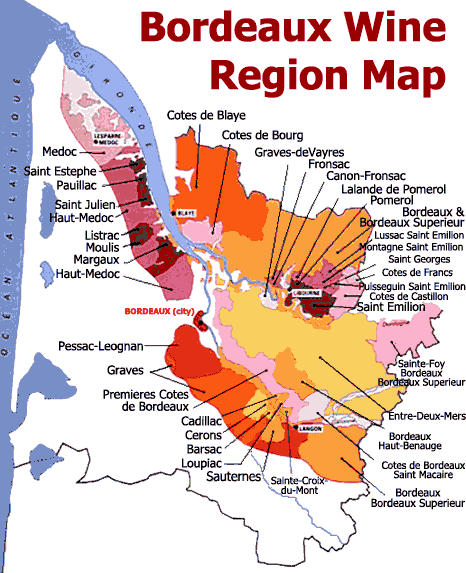
Here is a map of the various wine regions of Bordeaux. It may seem complicated at first but the more you learn about this area, the less daunting it will be. I highly recommend learning about Bordeaux by tasting your way through it. 🙂

http://www.terroir-france.com

If you’re not familiar with Bordeaux wines, then here are some key facts to get you started:

  • Bordeaux produces a wide range of wines from red, dry white, sweet, semi-sweet, sparkling and rose
  • Wines from Bordeaux are labeled by region and not by grape variety 
  • In general, Bordeaux wines are blends. This means that you’ll rarely see a wine from Bordeaux made from one grape variety. The main winemaking feature of the Bordeaux region is the creation of a balanced wine made from the blending of the various grape varieties
  • The major red grape varieties which are in general, blended, are Cabernet Sauvignon, Merlot and Cabernet Franc (sometimes Malbec, Petit Verdot and Carmenere are used)
  • The major white grape varieties are Sauvignon Blanc and Semillon
  • Some wine lingo:
    • “Left Bank” (refers to the area left of the Garonne river) – wines are usually Cabernet Sauvignon dominant in the blend
    • “Right Bank” (refers to the area right of the Dordogne river) – wines are usually Merlot dominant in the blend 
  • Sparkling wine from Bordeaux is Cremant de Bordeaux
  • Delicious sweet wines come from Sauternes, Loupiac and Barsac
  • Key feature of sweet wines coming from areas such as Sauternes is “noble rot” which gives the wine a unique flavour. Don’t worry, it’s a good thing and it’s delicious
  • Looking for a dry white? Try something from the region of Graves, Pessac-Leognan or Entre-Deux-Mers
  • A good introduction to the entire region as a whole would be to find a wine labeled as Bordeaux or Bordeaux Superieur. These wines can be made from grapes from anywhere in Bordeaux  
  • A wine from Bordeaux doesn’t have to be expensive to be enjoyable. There is something for every price point

As you taste wines from Bordeaux, make note of the region that it’s from. Whether it’s a general Bordeaux Superieur, Pomerol, Margaux or one of the many others, each region offers it’s own unique stamp to its wine.

http://www.smith-haut-lafitte.com

How to read a Bordeaux wine label interactive tutorial:
www.snooth.com/articles/commentary/how-to-read-a-bordeaux-label

The following dates for the Toronto “Bordeaux After Work Party” events are as follows: July 19, September 13 and October 25.

For more information about up-coming wine events in Toronto:

Also check out Bordeaux Wine on Facebook:
www.facebook.com/bordeauxwine

The main thing to take away from this post is that you can find a wine from Bordeaux for any occasion and to pair with any type of food. The options are endless! C’est magnifique.

Burgundy…my love

Inside the AGO

This past March, I attended the annual Vintages Burgundy Taste & Buy event. I look forward to this event every year. It’s like Christmas for me. Every delicious glass I smell and taste is like a gift from Santa himself. I was curious to see what this year would bring. The event is normally held at the King Edward Hotel but this year the venue had been moved to the Art Gallery of Ontario. Although the venue this year was more modern and spacious, I missed the catered food from the King Edward. The wine agents were all very nice and once we proved that we were serious wine tasters, they were quite eager to talk to us about their wines. So with the coiled wine list booklet,  I was off to do some tasting!

I love Burgundy

If you’re a lover of Pinot Noir and Chardonnay, then look no further than the region of Burgundy France. It’s amazing to taste the differences in wines that the region offers. Two wines from across the road can taste completely different from one another. This is the nature of Burgundy – diversity between wines made with the same grape.

Whenever I attend a wine tasting, I know that I’m not going to make it through all the wines. Even with all that spitting.  After I taste, I jot down a few brief points that are of interest and then I give it my own personal score.  I use a five point scoring system so when I refer back to my notes, it’s easy to see what wines really stood out. Three and above is what I give a wine that I consider to be good. Three  usually means “decent for the price”. Four and above is for a wine that I really enjoyed. I rarely give a five. A five would mean that the wine is soooo good, I’d be an idiot not to just run out of the room with the bottle – opened or closed. Wouldn’t matter. 🙂

Stephane Charreyron

The winemaker, Stephane Charreyron, from Domaine D’Ardhuy and myself. He was so much fun to talk to! He had a passion and enthusiasm for wine that just made me smile. His wines were absolutely delicious. This table was one of the highlights of my night.

www.ardhuy.com

Here are some of the other producers that I enjoyed at the show. Look for them at your local wine shop:

Domaine Jacques Prieur  www.prieur.com
Daniel Rion & Fils www.domaine-daniel-rion.com
Chanson Pere & Fils www.vins-chanson.com

Burgundian wines can be quite confusing. The region has over a thousand years of history and with some time, you’ll begin to taste the differences between the villages and producers. You’ll then find the ones that suit your taste. Here are some key facts that should get you going:

  • The main grapes used for winemaking are Pinot Noir for red and Chardonnay for white.
  • Burgundy wines are all about expressing the land from which the grapes originate.
  • There are five sub-regions in Burgundy to know: Chablis, Cote de Nuits, Cote de Beaune, Cote Chalonnaise and Maconnais – each of these regions have key villages and vineyards
  • Wine from the Chablis region will generally be white (Chardonnay) and un-oaked.
  • If the wine has a designation of AC Bourgogne (Appellation Bourgogne Controllee) then the fruit sourced to make the wine could have come from anywhere within the Burgundy region. These wines are often a good introduction to the area for not very much money.
Enjoy your next bottle of Burgundy! I know I will. 🙂

http://www.flickr.com/apps/slideshow/show.swf?v=71649

Through Rosé Coloured Glasses

Ah summer. It’s a time for sitting on patios, sipping on refreshing restorative beverages. A lot of us enjoy a crisp white wine during the warmer months but why not try a rosé wine next time when looking for something “restorative”.

On several past trips to the south of France I stayed in a restored Abby in a small village just outside of Avignon named Villeneuve-les-Avignon. Every morning I’d take a small stroll on the cobble-stoned roads, taking in all the sights and sounds of this small village. On one side of the street, a shopkeeper sweeping the outside of her store, saying hello to passers by. On the other side, a beautiful smell coming out of the small bakery where a man is putting freshly baked croissants out for the morning. As I continue my walk, I walk past a series of brasseries that are open for morning coffee. It always amazed me that at 10am, many locals were sitting on patios drinking rosé. In North America, if a person were to drink before noon, I think they’d be passed an AA meeting card! The south of France has a special place in my heart. Not only is the south home to the wonderful red wines of Gigondas, Rasteau, Vacquereas and the famed Chateuneuf-du-Pape but it is also home to the famous rosé wine-making regions of Tavel and Lirac. Perhaps this is why I have a soft spot for the pink-coloured wine. It’s a kind of staple in the south of France. That’s just what you drink on a hot summer day. For those who dislike rosé wines, why not try a wine that’s more full-bodied from the list below. You just might be surprised!

Rosé wines are made from red grapes (whether one variety or a blend of several varieties). They are left for a short time with skins during the wine-making process. This is why rosé wines are much lighter in colour than red wines. They vary from salmon pink to darker pink which can sometimes look almost red. Red wine is made from letting the grapejuice sit in contact with the skins, so the longer you let the skins have contact with the juice, the more colour will be extracted. A Rosé wine is nice if you want a wine that has characteristics of both red and white wines. It’s a nice compromise. They have the cripness of white wine and the fruit flavours of red wine. Grenache is one of the most popular grapes to make rosé wine with. Rosé wines are best when served slightly chilled.

Stratus Wildass Rosé 2007 $19.95
Ontario, Canada
Wow! This is my favourite rosé of the summer. It’s the Wine of the Month at the LCBO. It has a lot of beautiful aroma with the taste to match. It’s quite full-bodied and juicey for a rosé wine…almost reminds me of my favourite Tavel wines. WildAss is a label by Stratus.

Muga Rosé 2008$12.95
Rioja, Spain
This wine is quite dry and enjoyable. It is a blended rosé from Rioja in Spain, a mix of Tempranillo and Grenache and Viura (white).

Malivoire LadyBug $15.95
Ontario, Canada
80% Cabernet Franc, 12% Gamay, and the remaining 8% other vinifera
I tried this wine a few months back and thought it was lovely. Cute label!

Peller Estates Rosé 2007 VQA$16.95
Ontario, Canada
This wine is not really this colour that you see in the picture! The wine in the picture looks like bubblegum pink. I assure you that this wine is deeper in colour and lovely on the palate. http://vineyardsestatewines.com


Chateau D’Aqueria Tavel Rosé 2008 $19.95
Tavel, France
This was just delicious. Quite full bodied with lots of fruit and a long finish. yummy!
Also, this wine is from the Tavel region in France. You might want to drink this wine with some food because it is fuller bodied than a lot of the wines on this list.

I didn’t want the page to go on forever so I eliminated the photos for the next few…you get the idea-pinkish juice in a bottle. 🙂

Perrin & Fils Tavel Rosé $19.95
Tavel,France
Perrin & Fils is a well-known producer of good, inexpensive wines. They always maintain a consistent level of quality. I found this wine not a full-bodied and complex as the d’Aqueria (the wine above) but it was still quite nice.

Mas des Bressades Cuvee Tradition Rosé 2008 $13.95
Southern France
I haven’t tried this one yet but it is on my list of wines to try. It’s from the Costieres de Nimes region in southern France. It’s a blend of Grenache, Syrah and Cinsault grape varieties. Traditional southern French grapes.

Cave de Turchkehim Pinot Noir Rosé 2008 $16.95
Alsace, France
This wine has a lovely aroma. It’s soft on the nose and in the mouth. Made of the pinot noir grape, it has a lot of juicy strawberry on the finish. mmm…

Rabl Cabernet Sauvignon Rosé 2008 $16.95
Austria
Nice aroma on this wine. I can’t say that I enjoyed it as much as some of the others on the list. It’s a light, salmon-coloured wine from Austria and made from the Cabernet Sauvignon grape.

Tawse Sketches of Niagara Rosé 2008 $12.50
Ontario, Canada
I really wanted to try this wine and now I can’t seem to find it anywhere. Too bad! It looked pretty good.